
Bateman’s has 1634 carved above its main entrance, and Rudyard Kipling, who had recently declined both a knighthood and the post of Poet Laureate, bought the house and 33 acres in 1902, two years after first seeing it.
The National Trust's history of Bateman's records the date 1634 carved above the main entrance and the 33 acres Rudyard Kipling bought in 1902.
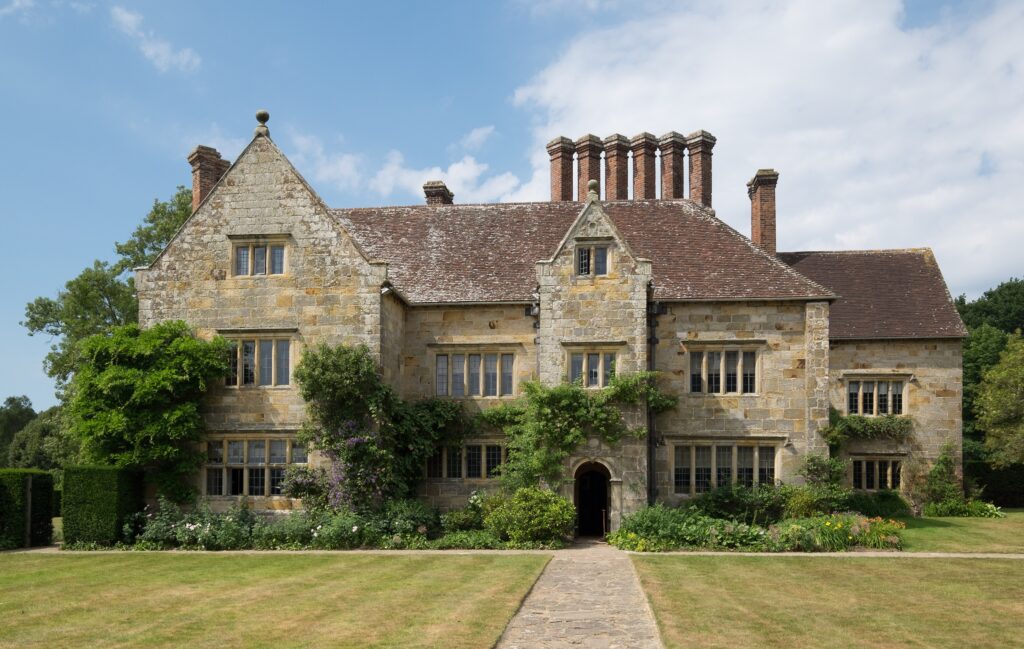
The date 1634 is carved above the main entrance at Bateman’s in East Sussex, the house Rudyard Kipling bought with its outbuildings and 33 acres of land in 1902, two years after he first saw it, according to the National Trust’s history of the property.
Kipling was earning around £5,000 a year at the time, which the Trust calls “an exceptionally high income”, and had recently declined both a knighthood and the post of Poet Laureate. He and his American wife, Caroline (1862–1939), first saw the house in 1900. Kipling, born in 1865 and died in 1936, lived and wrote at Bateman’s for over thirty years.
The Trust gives no purchase price. The Kipling Society’s reader’s guide, whose notes are based on those written by Thomas Pinney for the Cambridge edition of Something of Myself (1995), records that “Bateman’s, Burwash, Sussex, was bought by Kipling for £9,300 on June 10, 1902”.
A Sussex yeoman’s house in the Weald
Built in the early 17th century, Bateman’s was constructed and altered over several generations. The Trust says that although the 1634 date is cut above the entrance, some architectural features suggest earlier phases of building. The house is characteristic of a substantial Sussex yeoman’s dwelling, built from local sandstone with oak panelling and beams.
The surrounding area was once part of the Wealden iron industry, which ran in Sussex from the Roman period through to the early 18th century. Kipling believed Bateman’s had originally been built by an ironmaster, an idea prompted in part by the watermill nearby and by remnants of ironworking around it. The history of ownership before the Kiplings is incomplete and in places uncertain; parish records and estate documents indicate a succession of farmers, parsons and tradesmen.
The Trust’s account of the purchase carries a quotation on the house, printed without a named speaker: “We have loved it ever since our first sight of it… We entered and felt her Spirit – her Feng Shui – to be good. We went through every room and found no shadows of ancient regrets, stifled miseries, nor any menace, though her new end was three hundred years old… A real house in which to settle down.”
Electricity from a dynamo in the mill
The house kept its period features but needed substantial modernisation. With help from Kipling’s cousin, the architect Ambrose Poynter, the couple installed electricity, powered by a dynamo in the mill, upgraded the plumbing and reconfigured the kitchen and servant quarters.
Accounts of how the Kiplings reached the house differ. The Trust says they arrived by steam-powered car, a novelty at the time. The Kipling Society’s notes state that their first visit “was in fact by horse-drawn fly, August 14, 1900”, and that their second visit, on 26 May 1902, was made the same way because their car was out of order, citing Caroline Kipling’s diary.
Kipling set about the garden soon after settling in, creating an orchard, planting yew hedges and laying out a kitchen garden within the walls of what is now the Mulberry Garden, named for the mulberry tree he planted there. The rose garden beside the lily pond was also his design, and his original drawing is on display in the house. His daughter Elsie later recalled that he designed the outdoor spaces with the idea of the house “fitting into its surroundings like a lovely cup on a matching saucer”. The estate was expanded over time to more than 300 acres, with Carrie Kipling taking responsibility for its day-to-day management.
The family had settled at Bateman’s after the death of their eldest daughter, Josephine, from pneumonia in 1899. Kipling described it as “a good and peaceable place”. He collected Jacobean furniture, and family heirlooms and gifts from abroad, among them bronzes from South Asia and the Himalayas, Japanese lacquerware and works by his father, John Lockwood Kipling, were brought into the rooms. Many remain on display. Visitors included his cousin and future prime minister Stanley Baldwin, his aunt the artist Georgiana Burne-Jones, and explorers such as Sir Ernest Shackleton.
From family home to National Trust
Kipling wrote several major works in the study at Bateman’s, including Puck of Pook’s Hill and Rewards and Fairies. When composing poetry, or verse as he called it, he is said to have used the ticking of clocks or the rhythm of his own footsteps as a metronome, occasionally to the annoyance of guests in the room below. Addressing the Royal College of Surgeons in 1923, he said: “Words are, of course, the most powerful drug used by mankind.” Separate coverage looks at the first Royal Christmas Message.
Kipling was awarded the Nobel Prize in Literature in 1907 and remains its youngest recipient. The Jungle Book, Kim and the poem ‘If-‘ gained worldwide popularity. In 1915 the Kiplings’ only son, John, was reported missing in action at the Battle of Loos at the age of 18. His parents were unable to locate his body, and the loss marked Kipling’s later work, which moved from the idealising of service and sacrifice towards grief and loss.
After Kipling’s death in 1936, Carrie Kipling transferred Bateman’s and its contents to the National Trust in 1939, with the support of Elsie, the couple’s only surviving child. Carrie died later that same year. Elsie and her husband, Captain George Bambridge, had begun renting Wimpole Hall in Cambridgeshire in 1938 and bought the estate in 1942, using royalties from Kipling’s works to support its restoration. Elsie visited Bateman’s often and contributed to its early interpretation and care. Another writer’s country house in Trust hands is covered in an account of Churchill’s purchase of Chartwell.
Kipling was a vocal advocate of British imperialism, and the Trust says his legacy remains the subject of debate, with critics and readers continuing to reassess his influence, both literary and political. Over the past 85 years the Trust has worked to preserve and share the story of Kipling and of the wider family and the visitors who came to Bateman’s, with recent projects including the representation of the Exhibition Room within the house and interpretation co-curated with local and international partners. The house stands at Burwash in East Sussex, one of the properties that can figure in winter visits to National Trust houses.