
A bronze leg pulled from a bog at Milsington near Hawick in 1820 was long taken for loot, but experts now believe it came from a gilded statue of the emperor Antoninus Pius on horseback put up in southern Scotland about AD 140
A bronze leg found in a bog near Hawick in 1820 was long thought to be loot. Experts now believe it came from a gilded statue of Antoninus Pius.
A heavy bronze leg, larger than life and still wearing its boot, was pulled from a bog at Milsington near Hawick in 1820. For more than two centuries the assumption was that it had been carried north as loot from a Roman site further south, perhaps the major Roman town of York.
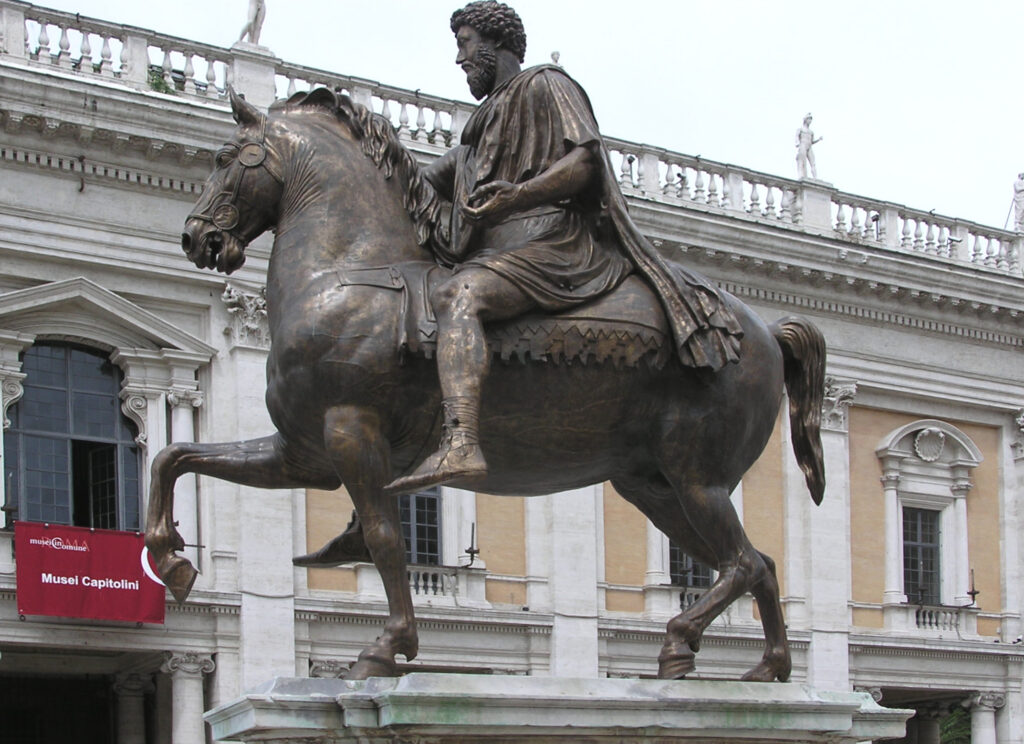
New research by National Museums Scotland has turned that story round. Experts now believe the leg came from a giant gilded statue of the emperor Antoninus Pius on horseback, similar to the one of his successor Marcus Aurelius that still stands in Rome, raised about AD 140 to mark the conquest of southern Scotland. The museum announced the findings on 12 November.
Dr Fraser Hunter, principal curator of prehistoric and Roman archaeology at National Museums Scotland, said: “This really turns on its head our understanding of Rome’s second attempt at conquering Scotland.”
The sculpture is the only known example of its kind from Scotland. Using the surviving leg, the museum has reconstructed what it would have looked like for a new exhibition in Edinburgh.
The leg was taken down with care
Much of the case rests on what is not there. The top of the leg carries no cut marks, and the bronze remains exactly as it was cast. That does not match a statue destroyed after a battle, pulled down in a formal condemnation of a disgraced emperor, or chopped up for scrap.
The gilding adds to the picture. Gold is missing around the knee, which shows that part of the leg was covered by a tunic or a cloak. Lumps around the top in-filled the folds of that garment and stuck the leg to it. Taken together, the detail points to a statue dismantled rather than wrecked.
That matters because it points at the Romans themselves. Careful removal and burial of Roman material has been found widely in Roman Scotland from the period when the Antonine conquests were abandoned, a withdrawal National Museums Scotland dates to the AD 160s or 180s. Inscriptions from the Antonine Wall and the Mithras altars from Inveresk, also going on display, were handled in the same deliberate way.
A wider study of Roman bronze imperial statues, equestrian ones included, found that they were put up at frontier forts. That makes a Scottish setting for a gilded emperor on horseback far more feasible than it long appeared.
The emperor who wanted his Scottish victory remembered
Antoninus Pius, who succeeded Hadrian, was emperor from AD 138 to 161, and the Antonine Wall was built in his reign. The barrier ran about 36 miles, or 58km, between the Forth and the Clyde, roughly 100 miles north of Hadrian’s Wall, through the central belt country around Falkirk, where boats are now lifted by the Falkirk Wheel.
Of all the emperors who sent armies into Scotland, only Pius paid particular heed to his victories there. It was the one foreign adventure he commemorated with the title Imperator, a battle-honour meaning “commander” that marked an emperor’s victory.
“This was a big deal for the emperor, something which was worth celebrating,” Hunter said. He added that the find “offers us a tantalising glimpse into the kind of grand monuments which once stood in southern Scotland and shows the importance Pius placed on his victories in Scotland”.
On this reading, the statue was raised to celebrate a conquest, and within a few decades the Romans took it apart themselves as they withdrew from southern Scotland.
The rest of the statue is still missing
Nobody knows where it went. The leg is all there is, and the identification is presented as what the evidence suggests rather than as a settled fact: a reading of casting marks, missing gilding and parallels at other frontier forts.
The loot theory held for more than 200 years. The researchers’ case is that a leg removed this carefully, with no cut marks, points to a deliberate Roman dismantling of a valued sculpture rather than a local act of revenge, or, as the museum put it, it was “carefully removed, not brutally hacked off”.
“But it begs the question – where is the rest of the statue?” Hunter said.
The answer may still be in the ground near Milsington, or scattered, or melted down long ago. For now, the leg and the reconstruction built around it are at the centre of Roman Scotland: Life on the Edge of Empire, which runs at the National Museum of Scotland on Chambers Street, Edinburgh, from Saturday 14 November 2026 to Sunday 18 April 2027, with tickets from £13.50, concessions available and free entry for members. The Inveresk altars sit alongside them, among finds from the decades when Rome pushed north of Hadrian’s Wall and then pulled back again.