
In 1986, David Gilmour of Pink Floyd bought a Thames houseboat built for Charlie Chaplin’s old boss, the band recorded most of their next album on it, and decades later he was still making records there
He found it for sale in a magazine in a dentist's waiting room. It had been built for Fred Karno, the music hall impresario who had Chaplin under contract, and Gilmour was still making records on it nearly 30 years later.
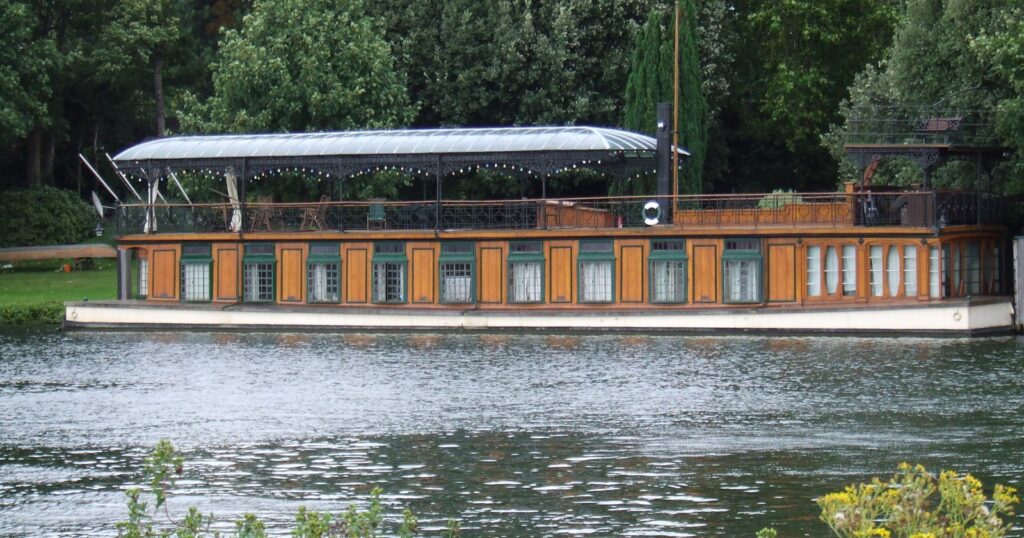
“I’ve never been keen on the traditional cellar that most studios are,” David Gilmour told Classic Rock in 2016. A studio of that kind, he said, meant “no windows, no natural light”. He was speaking on board the alternative he had found nearly 30 years earlier: Astoria, an Edwardian houseboat moored on the Thames at Hampton, in south-west London.
Gilmour bought the boat in 1986. It had been built for Fred Karno, the music hall impresario whose comedy company trained the young Charlie Chaplin. Pink Floyd made A Momentary Lapse of Reason on it, or “pretty much the whole” of it, in Gilmour’s words. Twenty years after he bought it, he was still recording there.
Karno’s floating showpiece
Karno was the stage name of Frederick John Westcott, who had made a fortune from music hall. Chaplin was one of his employees. The Charlie Chaplin Archive holds an agreement between “Fred Karno and Chas. Chaplin” dated 21 February 1908, and Chaplin toured America with Karno’s troupe until the movies came for him. When he signed with Mack Sennett’s Keystone studio in 1913, Keystone offered $150 a week for three months, then $175. That, the official Chaplin website notes, was more than double the $75 a week Karno was paying him.
Karno had money to spend on the river. He had bought a houseboat, Highland Lassie, at Tagg’s Island, near Hampton, in 1903. In December 1912 he took over the island and its hotel, and had the theatre architect Frank Matcham replace the hotel with the Karsino. He also had a new houseboat built, the Astoria, which he meant to be, in Elmbridge Museum‘s words, “the biggest and most luxurious houseboat on the river”. Richmond’s local history note describes richly panelled cabins and marble bathrooms, and Karno spent his summers on board.
The Karsino opened in 1913, little more than a year before the First World War began, and the hotel business never recovered after the war. Karno’s music hall business was losing ground to cinema and wireless, and he began selling assets, the Astoria among them. By the end of the 1920s he had been declared bankrupt. The hotel passed through several owners and was pulled down in the early 1970s. The boat outlived it.
Where the story goes soft
The boat’s early history comes mostly from local historians, and they do not agree. Elmbridge Museum dates the Astoria to 1913 and puts its cost at £20,000; Richmond’s local history note says around £20,000. Other accounts, including Tape Op and a Rock Atlas guidebook entry, give 1911. The two histories also split on whether Karno leased Tagg’s Island (Elmbridge) or bought it (Richmond), and on when he went bankrupt: 1927 or 1925. None of the notes we read cites a bill, a deed or a court record.
The Chaplin connection itself is on paper: the 1908 agreement survives, and so do the salary figures. The best Chaplin story attached to the boat is another matter. Classic Rock reported that Chaplin spent a night aboard in 1921, during his visit to England that year, and quoted him remembering mahogany panelling, staterooms for guests and “festoons of coloured lights”. We could not find that memory in My Wonderful Visit, his own account of the 1921 trip, or trace where else he said it.
A crane barge and a master bedroom
Some six decades after Karno’s bankruptcy, the boat caught Gilmour’s eye from a car. In an interview with a crew from New Zealand’s Newshub, which Houseboat Magazine reported in 2016, he said he was being driven past and asked the driver to pull over for a look. About two weeks later, in a dentist’s waiting room, he picked up a copy of Country Life, “and there it was for sale,” he recalled. “So I rang them up and came down and had a look and bought it.” We could not find a published price.
Phil Taylor, his long-serving guitar technician, oversaw the conversion. He told Tape Op in 2005 that the boat was five minutes from Gilmour’s house and was “a beautiful, furnished houseboat, with a caretaker living on board”. Gilmour first saw it as somewhere to write songs. Taylor turned the master bedroom into a machine room for the power amplifiers and tape machines. The cabin at the other end of the boat was fitted out as a live room. Getting the tape machines aboard took a crane barge and a tug, and they went in through a window.
“We then started work on the Momentary Lapse… album,” he said, “and everybody really liked being here.” It was the first Pink Floyd album since Roger Waters had left the band, and it came out in 1987. Seven years later the boat produced most of The Division Bell. “We made pretty much the whole of A Momentary Lapse Of Reason and The Division Bell in this room,” Gilmour told Classic Rock. That is his own estimate, given nearly 30 years after the first of those sessions.
Still at the mooring
Gilmour kept working there on his solo records. Sound On Sound reported in 2006 that his album On An Island was “recorded and mixed mainly” on the Astoria. His engineer, Andy Jackson, described the live room as “around 14 feet square” and said it “sounds fairly dead”. Asked about earthing a studio on a boat, Jackson said he had always thought they should just ground it straight into the river, “but no, we have gone to great lengths to optimise the electrics there”.
Rattle That Lock, released in 2015, was the most recent album recorded there when the guidebook Rock Atlas UK & Ireland listed the boat, in an entry that Louder ran in January 2016. When he talked to Guitar World about his 2024 album, Luck and Strange, he listed studios in Brighton and London, his barn at home and even a cathedral. He was speaking from the boat, which the magazine called his “creative nerve center since 1986”.
Karno built the Astoria to impress, with panelled cabins and marble bathrooms. When Gilmour first saw it, he has said, he did not even think of putting a studio in it: “It was just very, very beautiful, a magical place.” The recording gear came later, and with it the one thing the cellars never had: a view of the river.