
An Edinburgh antiques dealer paid £5 for a small walrus-ivory chess piece in 1964, and his family kept it wrapped in a drawer for 55 years, until Sotheby’s recognized it as a lost Lewis Chessman and it sold for £735,000
In 1964, an antiques dealer in Edinburgh bought a small, carved figure from another dealer in the city. It was a warrior about 9 centimetres tall, with a sword and a shield, carved from yellowed ivory. He paid £5 and wrote it down in his ledger as an “antique walrus tusk warrior chessman.”
He had no idea what he had bought. For more than half a century, the little figure sat wrapped up in a family drawer. When his grandchildren finally took it to Sotheby’s in London, the expert who examined it was stunned.
The famous hoard from Lewis
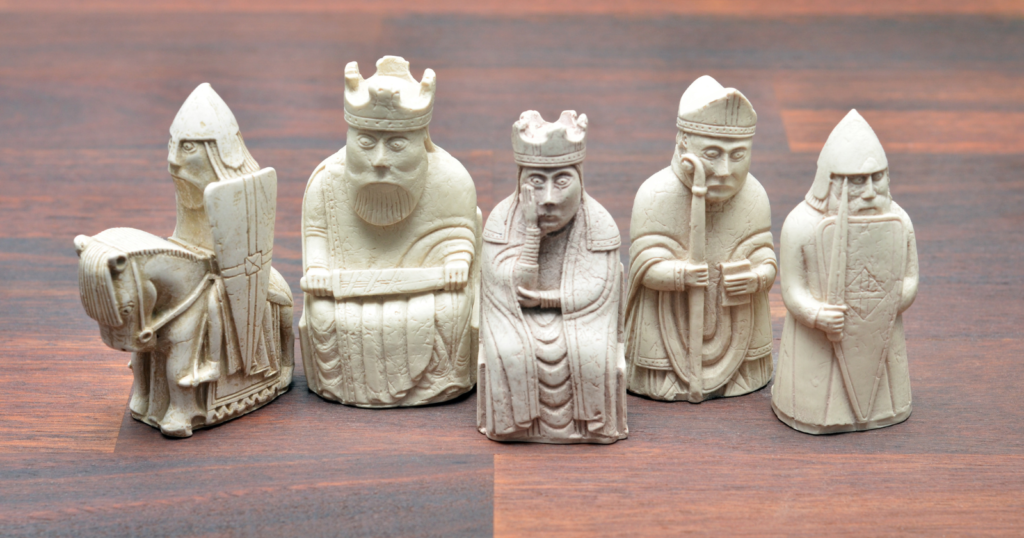
The figure appeared to belong to one of the most famous archaeological finds in British history: the Lewis Chessmen. In 1831, a hoard of 93 carved objects was found on the Isle of Lewis in the Outer Hebrides, including chess pieces, gaming counters and a belt buckle.
Exactly how they were found is unclear. According to one popular story, a local man discovered them in a sandbank or small stone chamber near the beach at Uig, on the island’s west coast. Within months, they were being shown at an exhibition in Edinburgh.
Kings, queens and berserkers
The chessmen were probably made in Norway, perhaps in the city of Trondheim, between about 1150 and 1200. At that time, the Western Isles of Scotland were ruled by Norway, which held them until 1266. Most of the pieces are carved from walrus ivory, with some made from whale teeth.
They’re famous for their expressive faces. The kings sit with swords across their knees, the queens rest their heads in their hands, and some of the warders, the pieces we now call rooks, are shown as berserkers, wild-eyed Norse warriors biting the tops of their shields.
Today, 82 of the objects are held by the British Museum in London and 11 by the National Museum of Scotland in Edinburgh. They are among the most popular objects in both collections.
The missing pieces
When the hoard was found, it didn’t make up complete chess sets. Comparing the surviving pieces with the number needed for full sets, historians believed several major pieces were missing, including four warders.
How the pieces came to be separated, and where the missing ones went, has long been a mystery. The Edinburgh family’s warder may be one of them.
“Oh my goodness”
After the dealer died, the chessman passed to his daughter. She kept it carefully wrapped in a small bag in a drawer at home. Her family later said she was very fond of it, admiring its intricate carving and quirky character, and believed it might even have some magical significance.
In 2019, the next generation of the family took it to Sotheby’s for a valuation. Alexander Kader, the auction house’s expert in European sculpture, told the BBC his jaw dropped when he saw it. He later spent a year researching the piece and comparing it with the chessmen in the national collections.
A record sale
On 2 July 2019, the warder was auctioned at Sotheby’s in London. It sold to an anonymous buyer for £735,000, a world record for a medieval chess piece and the first time one of the Lewis Chessmen had come up for auction.
Not everyone was convinced. Both the British Museum and National Museums Scotland declined to bid, with the Scottish museum saying its link to the Lewis hoard couldn’t be proven beyond doubt. Sotheby’s attributed the piece to the same workshop that made the Lewis Chessmen, based on its style, material and size.
A reminder to check the drawer
Whatever its exact origins, the warder’s story is a remarkable example of treasure hiding in plain sight. A figure that once cost the price of a meal sat unrecognised in an Edinburgh home for decades, even as its relatives drew crowds in two national museums.
Somewhere, the other missing pieces may still be waiting, perhaps in an attic, a shop window or a box of old ornaments. Their famous cousins remain on display in London and Edinburgh, still pulling faces at visitors nearly 900 years after they were carved.