
A Daily Express page from 27 November 1968 was found behind a skirting board at Tamworth Castle during its £1.9 million restoration, and a Woodbine packet believed to date from around the 1950s or early 1960s turned up above a ceiling
A Daily Express page from 27 November 1968 was found behind a skirting board in Cooke's Bedroom at Tamworth Castle during its £1.9 million restoration.
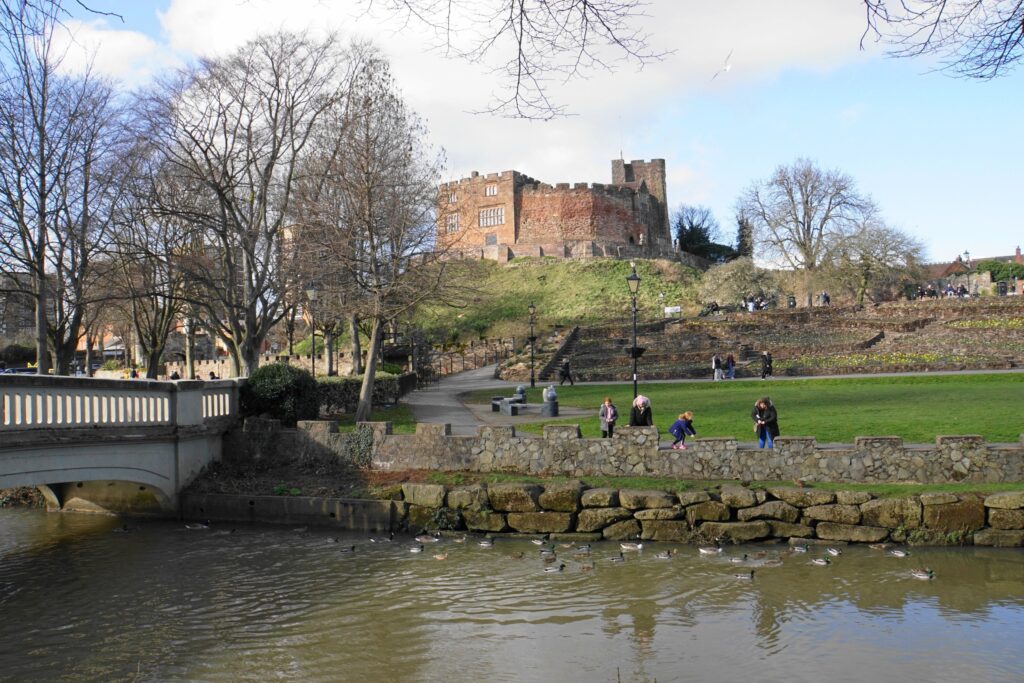
A page of the Daily Express from Wednesday 27 November 1968 has been found behind a skirting board at Tamworth Castle, where a £1.9 million restoration is under way.
The newspaper page was in Cooke’s Bedroom. Its front-page headline is ‘Later to School’. Tamworth Borough Council announced the find on 25 November. It also revealed that workers had found a Woodbine cigarette packet believed to date from around the 1950s or early 1960s.
The packet was found when the ceiling on the south side of the castle was taken down. The council said its position above a ceiling raises the possibility that it was left behind by someone working on the building during an earlier programme of repairs or alterations.
Councillor Lewis Smith, Tamworth Borough Council’s portfolio holder for people services, engagement, leisure and heritage, said: “These may be everyday objects, but discovering something that has been hidden above a ceiling or behind a skirting board for decades gives us a very human connection to the people who were here before us.”
The finds were made during phase two of the council’s Museum Estate and Development Fund (MEND) restoration programme. Specialist teams are now working in the castle’s South Wing.
The council describes the work as the biggest conservation project in the castle’s modern history. Ceilings, skirting boards and other parts of the building are being opened up so that conservation work can take place.
A newspaper page from 1968
The council said the Daily Express page had given the conservation team a time capsule from 1968.
Other stories visible on the page include a report about cigarette companies battling to keep prices down.
The council said that although the finds may appear to be ordinary objects, the places in which they survived make them part of the castle’s more recent history.
The Woodbine packet
The pale green packet bears the name of its manufacturer, W.D. & H.O. Wills of Bristol and London. It also carries the words ‘Made entirely of Fine Virginia Tobacco’ and ‘Branch of the Imperial Tobacco Company (of Great Britain & Ireland), Limited’.
Part of the original foil lining is still inside. The packet carries the slogan ‘Wills for Quality’.
W.D. & H.O. Wills introduced the Woodbine brand in 1888. It became particularly well known during the first half of the 20th century and was associated with British servicemen during the two world wars.
The brand’s longstanding packet design was changed during the mid-1960s. The council said the design of the Tamworth packet appears consistent with a mid-20th-century example.
Councillor Smith said: “The Woodbine cigarette packet is particularly intriguing. Someone may have left that packet behind decades ago, never imagining that another generation working on the castle would eventually find it.”
Timber from an old tea chest has also come to light in the ceiling of the Georgian Room. It appears to have been reused as part of the ceiling structure.
With the ceiling covering removed, sections of the timber can be seen fixed alongside the supporting timbers. Fragments of the chest’s original stencilled lettering are still visible, including the words ‘Paris’ and ‘Grand’.
The council said the tea-chest timber appears to have been given a practical second life within the building.
A hidden sink
An earlier find was made in September in the Townshend Room gift shop. Contractors uncovered an intact lead-lined sink hidden in a deep windowsill, concealed behind a rigid board.
The sink is believed to date from the 18th or 19th century. The council said it suggests this part of the castle may once have been used as a pantry or other domestic service room.
The lead was shaped over a wooden structure, and the individual drainage holes were punched by hand. The council said the sink is in excellent condition.
It will be protected and re-covered as restoration continues, preserving it in place for the future.
Councillor Smith said: “One of the fascinating things about carrying out conservation work on a building with almost 1,000 years of history is that you never quite know what you might uncover.”
The council traces the castle’s story from an Anglo-Saxon centre of power through Norman and medieval times to the Tudor period and on to the Georgian and Victorian eras.
The conservation programme is supported by £1,716,238 from Arts Council England’s Museum Estate and Development Fund and £190,695 from Tamworth Borough Council.
Tamworth Castle was placed on the Heritage at Risk Register in 2023. The council said the MEND programme is dealing with some of the most urgent structural and conservation problems facing the building.
British Heritage has also reported on Holbeche House in Dudley and Damien Hirst’s Toddington Manor, both of which Historic England has placed on its Heritage at Risk Register, and on the reopening of the Norman keep at Canterbury Castle.
Future work will include the North Wing. There the programme will focus on stabilising bay windows and walls, along with historic openings, that have moved over time.
Work is also planned on the motte and the slopes that support the castle.
The works are being phased so that as much of the castle as possible stays open to visitors. The council said scaffolding, temporary closures and disruption will continue while the work goes on.
The council directs readers to Caring for the Castle for background and to follow the restoration.