
David Beckham paid a reported £6.15 million for derelict barns near Chipping Norton, where Jeremy Clarkson farms, without telling Victoria, then sat her down with a vodka and tonic to break the news
David Beckham says he found the Great Tew barns by chance, bought them within a week and told Victoria afterwards. Here is what the reports of the price show, where the £12 million figure came from, and what survives of the village around them.
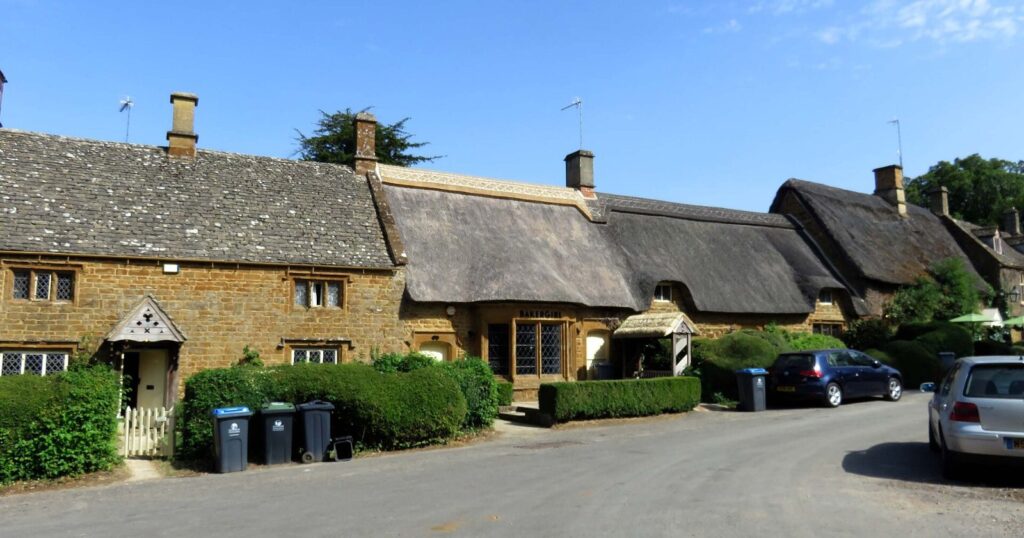
After six months of house-hunting, David Beckham was driving past a cluster of ruined farm buildings outside Chipping Norton, in Oxfordshire. He called a halt, and “within a week, I’d bought it,” he told Alan Titchmarsh in Country Life, in the October 2025 issue he guest-edited. The earliest report of the price that has surfaced, from August 2017, put it at £6.15 million, paid in December 2016.
His wife was told afterwards. “I bought it without telling Victoria. She didn’t want another project. We’d just done up the London house. I sat her down, gave her a vodka and tonic and told her what I’d done.”
If Chipping Norton sounds familiar, that is Clarkson’s Farm. Jeremy Clarkson farms Diddly Squat, and its shop gives its address as Chipping Norton Road, Chipping Norton. The two are not neighbours in any strict sense: Diddly Squat lies south of the town, in the parish of Chadlington, while the Beckhams’ barns are north-east of it, near the village of Great Tew.
The £6.15 million and the £12 million
Two numbers follow this property around, and only one of them is a price. The Daily Star Sunday gave £6.15 million in August 2017. The Telegraph, in January 2018, gave £6.1 million, paid in December 2016. Later coverage has repeated £6.15 million, and one magazine piece this year put it at “around £6.5 million”.
The definitive record is the Land Registry title, a paid document not consulted for this piece. The Land Registry’s free price-paid data shows no Great Tew sale at that level between mid-2016 and the end of 2017, but it does not cover every transaction. The £6.15 million used here is the earliest reported price found, and the Telegraph’s figure is consistent with it.
The £12 million is not a price at all. It comes from a 2022 study by the comparison site Money.co.uk, which asked an unnamed estate agent from housebuyers4u.co.uk to estimate what the renovations had added. Hello! wrote that “the research concluded” the family had taken the property “from around £6million to £12million”. No method was published, the home has not been sold, and no independent valuation is public. Repetition has since made the estimate the home’s routinely quoted value.
Two barns, a thatch and one maple
Beckham’s brief was simple. “I knew that, if I picked the right location and the children could get there in a day from London, they’d come,” he told Titchmarsh. He took the family to see the ruins and told them they would not be back until the work was done. “Fourteen months later, on December 17, I brought them back when the house was finished.”
Country Life describes the starting point as two derelict Cotswold-stone barns, one thatched and one stone-tiled, on 26 acres that were once part of the Great Tew estate. A third building was added, and the three were joined into one long range in the shape of the letter E. Some earlier press coverage counts three barns from the start.
When the Beckhams arrived, Titchmarsh writes, “there was but one tree: a maple.” Hundreds more have gone in since, with pines and maples predominating among hornbeam, oak, yew and beech. A lake was added during lockdown, and a bee garden holds four quartets of WBC hives.
The family story exists in more than one version. In the one Country Life’s editor tells, as reported by Hello!, Beckham warned Victoria she would not be back for 18 months. In his own account to Titchmarsh, the work took fourteen. The vodka and tonic rests on his word alone, and Victoria Beckham does not appear to have told the story herself.
A listed house with a long paper trail
The property is Grade II listed, as the Telegraph noted in 2018. In May 2026, West Oxfordshire District Council’s planning notices advertised an application for listed building consent at Maplewood Barn, Great Tew, the name it goes by in council records. Changes to the fabric of a building like this need the council’s approval, and every application goes into a public planning file.
Some of those files have drawn attention. In January 2018 the Telegraph covered an application for a tree house that Sarah Holland, clerk of Great Tew parish council, said had already been standing for at least two weeks. The application, dated 12 December, said work had not started. A spokesman for the couple confirmed the information was correct and declined to comment further.
In March 2026 a neighbour, James Worthington, lodged a 43-page objection to plans that included pond lighting. “Is this really Great Tew or have I mistaken this area for Blackpool?” he wrote, according to LBC. The same set of plans included planting 79 trees and creating a wildflower meadow.
Falkland’s village
Long before footballers, Great Tew had a famous resident. The Victoria County History of Oxfordshire says the village “was known chiefly as the home of the ‘blameless’ Lord Falkland”. Lucius Cary, 2nd Viscount Falkland, gathered a witty and learned circle there in the 1630s, one that Edward Hyde, Lord Clarendon, later described in detail. Falkland was killed fighting for the King at the battle of Newbury in 1643.
His manor was a large E-shaped building of the early 17th century or earlier. It is gone. According to the county history, G. F. Stratton demolished it around 1800, though parts were still standing in 1815. The Beckhams’ barns now echo its shape, some two centuries after it came down.
Much of the village a visitor sees today is younger. Matthew Robinson Boulton, son of the Birmingham industrialist Matthew Boulton, bought the estate in 1815 and 1816, and rebuilding in a consciously “picturesque” style followed soon after. The county history dismisses one local legend, that the landscape gardener John Claudius Loudon laid out the village, as “a tenacious myth”. Loudon did come, around 1808, but to run what the history calls “an extravagant and unsuccessful model farm”.
After 1914 the estate passed to the Public Trustee. Farm buildings were neglected and cottages decayed, and the population fell from 334 in 1901 to 204 in 1951. In 1978 the village was declared a conservation area.
Among the buildings older than Boulton’s work, two stand out. The Falkland Arms, listed Grade II, is dated by Historic England to the late 17th century, possibly partly earlier. It still trades as a pub, and the county history says it had taken Falkland’s name by the 1830s. The parish church of St Michael and All Angels, listed Grade I, dates from the late 12th century and was restored in 1827 by Thomas Rickman, the architect Boulton engaged for the estate.
The Beckhams’ home is private and not open to visitors. The Falkland Arms welcomes them, and Clarkson’s farm shop on the Chadlington road opens Tuesday to Sunday.
As for the woman who did not want another project, her husband says she has come round. “She’s in love with it,” he told Titchmarsh. “She sleeps longer here.”