
A skeleton found in a Roman coffin at Westminster Abbey, missing for years until it turned up inside the sarcophagus in 2016, is probably an abbot who died around 1020, Warwick Rodwell says, after carbon dating put the burial between 987 and 1052
A skeleton in a Roman sarcophagus at Westminster Abbey is probably an abbot who died around 1020, Warwick Rodwell says, after dating put it at 987 to 1052.
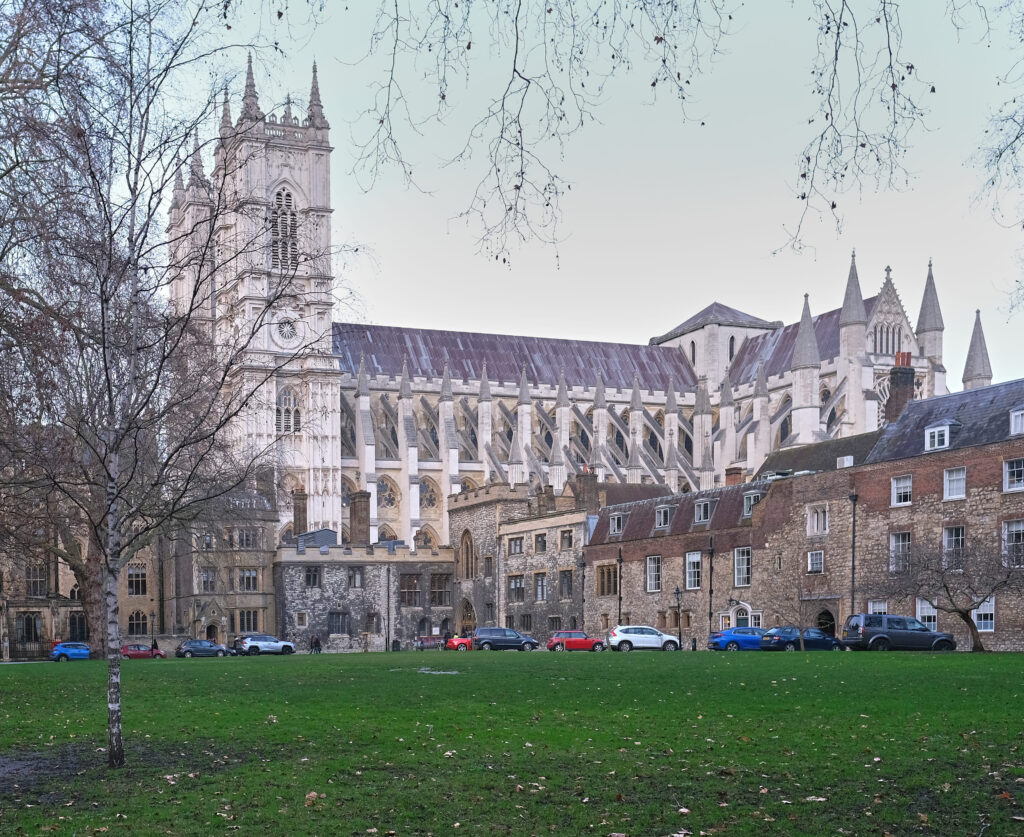
A skeleton that written records suggested had been lost was lying inside a Roman stone coffin at Westminster Abbey the whole time.
And the man inside was probably an abbot who died around 1020, according to new analysis by Professor Warwick Rodwell, consultant archaeologist at Westminster Abbey.
Carbon dating at the Scottish Universities Environmental Research Centre placed the burial between 987 and 1052 AD, centuries later than the Roman-era Briton whose name is cut into the coffin.
The limestone sarcophagus was excavated on the Abbey’s North Green in 1869. It bears an inscription to Valerius Amandinus, a wealthy Briton who lived in the city around 300 to 400 AD.
Sculpted on the lid, however, is a Latin cross dating from approximately the 10th or 11th century. That suggests the human remains found inside belonged to someone who died many centuries later, when the coffin was reused.
Rodwell’s analysis, published in the peer-reviewed Journal of the British Archaeological Association and reported on 21 October 2026, concludes that the bones belonged to a high-ranking medieval monk.
He believes the most likely candidate is Aelfwig, who died around 1020 after a career as an Abbot at Westminster Abbey, then a Benedictine monastery. Another is Aelfwig’s successor Wulnoth, who died in 1049 and is presumed to have been buried at the Abbey, as was Aelfwig.
“We have two viable contenders for the occupant of the sarcophagus,” Rodwell said. “We do not know the date of birth of either. But either would fit equally well if we assume the Abbot was in his early twenties when the appointment was made and close to fifty when he died. The fact Aelfwig was already a monk of Westminster might favour him.”
Lost, then found under the lid
In his article, Rodwell sets out how it had been believed the skeleton was lost.
That turned out not to be the case. The stone coffin was sent to a conservation studio in 2016, and when researchers from Pre-Construct Archaeology lifted the lid they found, to their surprise, an almost-complete skeleton inside.
They also found a white lime residue outline of a rectangular structure. “Although no physical traces of that feature remained, it can only have been a timber coffin, which has completely decayed over the course of the seven centuries that the sarcophagus was buried in the sacristy courtyard,” Rodwell wrote.
James Young Langthorne, human bone specialist at Pre-Construct Archaeology, put the dead man’s age at between 35 and 49 and his height at around 5ft 9 ins.
That differs from an assessment in the 1800s, which suggested a “robust young man” of around 5ft 7ins, aged no more than 30.
What the dating shows
A bone sample was sent to the Scottish Universities Environmental Research Centre for carbon dating, which returned a result of 987 to 1052 AD.
“This confirms that the reuse of the sarcophagus, and the associated remodelling of its cover, occurred in the late Saxon period,” Rodwell said in the Taylor & Francis newsroom announcement of the research.
A Roman coffin put back to use
Another clue pointing to an abbot, Rodwell says, is the way the body was treated. The occupant was “honoured” with a “fine sarcophagus”, and his wooden coffin was placed inside the stone burial casket in what could represent an early example of recycling. The lid was then re-carved to feature a large Latin cross.
The coffin’s modern history has been rough. In 1820, workmen accidentally unearthed the sarcophagus on the north side of the Abbey and smashed the lid into six pieces. The damage was repaired when the Roman coffin was later officially “discovered” in 1869.
That same area, the site of King Henry III’s original sacristy, was examined by Time Team in 2009. A later excavation of the sacristy by Pre-Construct Archaeology was completed in 2025, work needed to allow the building of the King Charles III Sacristy at the Abbey, which is set to open next year.
It is not the Abbey’s only story of something going astray. On Christmas morning in 1950, four students stole Scotland’s coronation stone from Westminster Abbey, broke it in two and were never charged.
The sarcophagus itself is on permanent display in the Abbey museum, the Queen’s Diamond Jubilee Galleries. Westminster Abbey set out the findings on 21 October 2026.
The same church has been the setting for British coronations since the Middle Ages, a ceremony British Heritage traces in a history of the coronation.